Monthly Archives: February 2013

What’s a eurosceptic?

It’s a label I dislike, and not just for the obvious reasons; but it’s the label that has stuck, so let’s be clear what we mean by it when we use it.  Here’s my understanding of the term:

A eurosceptic is someone who wants less European Union.  It’s an existential thing.  There are shades of grey: a eurosceptic might be opposed to his or her country being a member of the EU; or they might think that the EU should be watered down in some way; or they might want the abolition of the entire project.  But, generally speaking, we can presumably agree that a eurosceptic is looking for less EU.

A eurosceptic is NOT someone who opposes, dislikes, is unhappy with, hates a current EU policy.  You might disagree with the CAP; you might hate the common visa policy; you might think that the EU’s environmental legislation is much too weak; you might think that the EU’s working time directive is an outrageous burden on business.  These are not existential arguments against the EU; they are arguments against current EU policies.  Holding those views does not make you a eurosceptic, though of course you might *also* be a eurosceptic.

The two concepts get muddled all the time.  Why is that?  We don’t see this confusion in national politics.  Most politically literate people don’t call for the abolition of national government from Westminster because they oppose cuts to benefits, or the Iraq War, or the stealth privatisation of the NHS, or gay marriage.  If there’s an issue in national politics which bothers you, you might go out and vote for someone who agrees with you; or you might write to your MP; or you might go on a demo; or you might even get involved in party politics yourself.  But you’re not usually a UK-sceptic.

Clearly, this is part of the EU’s problem.  We need to ask ourselves how we can develop a greater sense of engagement by citizens in the European tier of government and politics.  The fact that the EU’s citizens don’t feel sufficiently engaged to seek to influence policy, the fact that they conflate the policy of the current Commission with the entire edifice of the European Union itself, is a real challenge.  It might in fact be a legitimate ground for euroscepticism.  But the policies themselves – the CAP, the austerity, the fisheries, the working time directive… these are not legitimate grounds for euroscepticism.

Ask yourself this: if the EU were to ditch a policy you hate, and introduce a policy you love, enforcing it throughout the EU and using its international muscle to establish it as a global norm, would you still think that the EU is a bad thing?  If not, then you’re probably not a eurosceptic.

Democratic accountability – a comparison

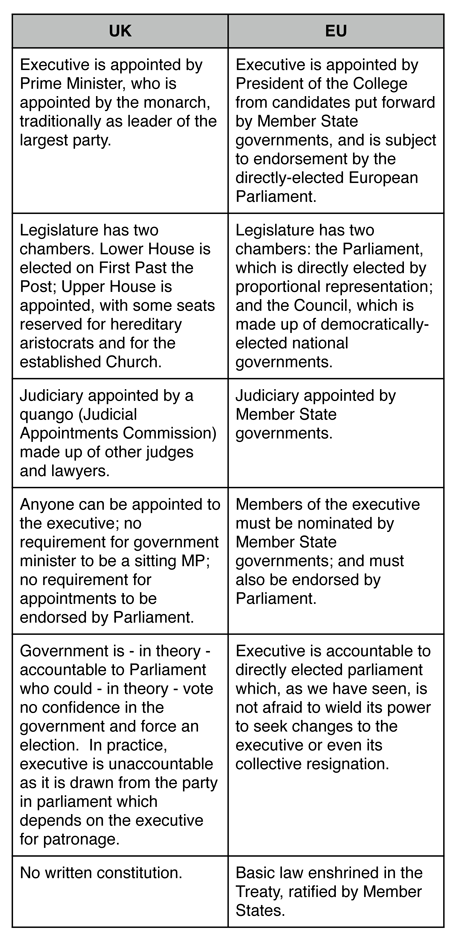
Just how undemocratic is the EU compared to the UK?  Well here’s a quick and dirty comparison – don’t hesitate to correct me if I’ve got something wrong, I’m not a political scientist nor a constitutional lawyer.

comparison


Edit – as @FrazerGoodwin points out, the table doesn’t tackle the whole issue of Royal Consent, and the role of the British monarchy in UK law-making.  In case you think that’s purely ceremonial, with no real impact on modern-day legislation, think again.

Edit (September 2017) – I wrote this piece a long time ago, long before any of us really imagined that the UK might vote to leave the EU. A lot has happened since I wrote it, and quite evidently my arguments have fallen on deaf ears, because democratic legitimacy is still cited as a key factor by many who voted to leave. One major change since 2013 was the introduction of the Spitzenkandidat procedure for the 2014 European Parliament elections. This now means that the leader of the EU’s executive (the President of the Commission) enjoys the same degree of legitimacy as the leader of the UK’s executive (the Prime Minister) – in fact – and I would argue more, in law, as the UK’s chief executive is the leader of the largest party only by convention and not by constitutional law.

The EU: a union of state bureaucracies?

Jean Monnet said that we are not building a coalition of states; we are creating a union of peoples (“nous ne coalisons pas des États, nous unissons des hommes”).  So no, in response to @brunobrussels, we are certainly not a union of state bureaucracies; or, at least, that’s not what we aspire to.

But what’s the reality? Has the EU successfully delivered Monnet’s vision?  Or has it fallen short?

I think I answer that question partially in my previous post (Institutional Imbalance), but I still feel that Bruno deserves more of a reply.  I detect in his reaction – and I hope he’ll correct me if I’m wrong – the premise that power belongs more naturally with nation states and national parliaments, and any move to transfer sovereignty to a higher tier than the nation state effectively strips sovereignty away from its democratic home.

In his excellent book ‘Guns, Germs & Steel’ Jared Diamond describes how people have historically organised themselves in ever-more-complex configurations: bands, tribes, chiefdoms, states; and then those states evolve into ever larger structures, with ever larger numbers of citizens.

Diamond argues that humans have a strong interest in forming part of ever-larger state incorporations; but also that they tend to have a strong vested interest in the status quo.  As a result, they tend to resist upward incorporation even at the expense of their own longer term interests.  External pressure is usually needed to force the upshift to broader political structures (again, see my previous post); but, when this is realised, it tends to benefit all members of that new, larger, political structure.

To my mind, Diamond’s thesis offers a clear understanding of the tendency towards euroscepticism but also why this tendency is an historical dead end.

The nation state is no more ‘natural’ a political unit than any other, including the EU.  Arguments against the EU which are premised on the notion that the nation state has more legitimacy qua nation state than any other political structure are, I strongly believe, fundamentally flawed, and guilty of historical subjectivity.

Of course, there are those who argue that the EU’s structures are less democratically accountable than its Member States’, and that this means that sovereignty should revert to those Member State structures.  But this isn’t an argument against the EU.  It’s an argument – right or wrong – for reform of the EU’s structures so that they become more democratically accountable.

(Aside: I managed to squeeze the above into five tweets, but thought it preferable to go long form rather than spam people’s twitter feeds. This shows how useful Twitter is as a tool for forcing you to get your point across in as few words as possible.)

Update added at 15.46 CET 20/2/13:

It’s been suggested that I don’t really address the question of whether Monnet’s “Union of People” has been achieved.  What many eurosceptics fear is that the EU represents Big Government washing out the power of individuals.  It has also been put to me that the EU is an elite project which seeks to remove politics above society.  Let’s take these charges one by one.

Does the EU seek to remove politics from society?  This one is easy: of course it doesn’t.  If it did, why would so much money and effort be put into attempts to legitimise the EU with its citizens?  You might argue that those efforts are not very effective, but you cannot deny that those efforts are made.

Is the EU an elite project?  I see this as a meaningless question.  Restructuring a society’s political system has always been the task of an elite; Robespierre, Trotsky and the Gracchi belonged to an elite.  Popular support, or democratic legitimacy, is of course a different matter, but let’s save that one for another day.

Is the EU “Big Government”?  As Diamond argues, government has a tendency to become bigger over time, if by bigger we mean extending into more areas and bringing more people under its wing.  But what about ‘big government’ in the passive-aggressive, dismissive sense used by certain libertarians who fear that citizens are excluded from the decision-making process, or that government takes decisions about citizens which are none of its business?  In this respect, the EU is no worse, and probably a lot better, than most of its Member States.  EU competence is very clearly defined in a Treaty which has been negotiated by the Member States and ratified by the Member States.  There is double democratic legitimacy: firstly, through its Member States which are all representative democracies and which both appoint the executive and form one chamber of the legislature; and secondly, through the directly elected European Parliament, forming the second branch of the legislature.  I’m not going to address the question of whether this democratic legitimacy is sufficient, except to say that I personally think there are flaws; but to paraphrase Churchill, no-one pretends that EU democracy is perfect or all-wise.  It’s the best we have, until we put our heads together to make it better.

Does the EU wash out the power of individuals?  As soon as humans started organising themselves into political structures larger than the family, individuals gave away some control over their own lives in return for a higher degree of security.  Modern political structures attempt to find a compromise between the benefits which accrue from collective decision-making and the desire we all have to make independent decisions about our lives.  In this respect, too, the EU is no worse and probably a lot better than most nation states.

One final point: far from excluding the individual, the EU is there to benefit the individual citizen.  This is hard-baked into the Treaty.  The EU provides its individual citizens with many rights and freedoms which are guaranteed by the Treaty.  Those rights and freedoms should not be taken for granted.  Outside the EU, they might come under threat.
Institutional imbalance

A very good article written by Isabelle Durant MEP in the context of this week’s Budget Summit (“Van Rompuy’s Silent Coup d’Etat“) touches on a theme which is close to the hearts of those of us who feel that the institutional balance in the European Union is off kilter; namely, the overweening power of the Council. As @eurocrat astutely observes, perhaps this is an area where there is some common ground between EU federalists and eurosceptics? (Perhaps, though our common distaste for what we see as a democratic deficit leads us in very different directions.)

In 2004, I was asked to give a talk to students at Concordia University in Montreal on the topic of EU enlargement (the ‘big bang’ having only just occurred). This gave me an opportunity to explore some of the big questions: widening versus deepening; the community approach as opposed to supranationalism; and what the EU is actually for.

I’m posting the text of the talk I gave below. To summarise, my conclusion was that things had gone to the dogs since Maastricht, but perhaps that didn’t matter as the EU had already done what it was created to do: make Europe a secure and peaceful continent.

Also on the panel with me was the Dutch Ambassador, who was not happy with the talk I gave. He tore up his own prepared text and used his slot to tear into mine; but I think he kind of made my point for me.

Anyway, here it is.

It can be difficult for non-Europeans to appreciate quite what a new thing the European Union is on the international stage. When people think of the European Union, sometimes they see it as a kind of souped-up NAFTA, a free trade area on steroids. Or, they see it as a mini-United Nations, a force for international law and stability in the region. The truth is that the EU is both these things, but it’s also much more than that.

To understand today’s European Union, we really need to go back and appreciate the motivation of its founding fathers. They had grown up in a Europe almost constantly at war with itself. Millions had died, economies had been shattered, Europe’s leadership in world affairs had been given away to the United States and the Soviet Union. Europe had to find a new way of living with itself. The European Economic Community was not just about rebuilding economies – it was about surviving in a new world.

I make that rather dramatic observation because I think it’s fundamental to the understanding of the way the EU has evolved, and continues to evolve. The members of the EU have all been prepared to sacrifice part of what it is to be an independent country in order to safeguard the security and prosperity of their citizens. The EU plays a direct role in the everyday lives of nearly half a billion people. In an increasing number of areas, policy is made at the European level, not in national capitals. European governments have voluntarily given away their powers, pooling sovereignty in exchange for peace, prosperity and global influence. It’s multilateralism taken to its logical conclusion.

The history of the EU’s evolution also needs to be seen against this backdrop. If World War II was the shock that Europe needed to embark on the road of political union, then the Cold War was the constant threat that kept the European project on the rails. I think that this is something that we’ve only really been able to appreciate in hindsight. With the end of the Cold War, we saw two developments in Europe which have arguably changed the path of European integration:

The first development was the disappearance of the obvious external threat on our doorstep, and the demilitarisation of the continent. The second development was the realisation, if you like, of the European dream: war between the nations of Europe was no longer imaginable. It is simply impossible for a European of my generation to imagine one Member State of the EU going to war against another. As a result, European security was no longer the driving force behind European integration. A new generation of Europeans was no longer bound by the post-war taboo against nationalism. With the success of the EU, so resentment against the encroachment of the Brussels machine in daily life has grown, not only in traditionally “eurosceptic” countries but right across the EU.

My own view is that future generations may see the late 80s and early 90s as the high tide mark of European integration. With the Single European Act of 1985 and the Maastricht Treaty of 1992, we finally saw a comprehensive economic union, going even beyond the level of economic integration seen in many sovereign countries – Canada being one example. We also saw a significant step towards political union, with EU Member States deciding to work together also in the fields of foreign policy, security policy, justice issues and home affairs (what we call the second and third pillars of the EU – with the original European Community remaining as the first pillar).

But the Maastricht Treaty also saw the first major watering down of the ‘Community’ approach. Traditionally, the European Commission had always played a central role in European policy making. As the executive, the European Commission was the originator of policy proposals, which then went to the Member States (acting as the European Council) and to the European Parliament for amendment and approval – often by a majority vote. This is known as the ‘Community’, or ‘communautaire’, approach. Now, with the Maastricht Treaty, the European Council itself is the executive branch of government – at least, for foreign policy and security policy issues, and most justice and home affairs issues: that is to say, second and third pillar issues. The role of the other institutions, the European Commission and the European Parliament, is sharply reduced. In addition, the EU can only take decisions in the field of foreign and security policy by unanimity. This ‘supranational’ approach is an entirely different kettle of fish to the really unprecedented level of integration which exists in the First Pillar.

Hang on, you say. Didn’t the EU launch its own single currency a couple of years ago? Aren’t you debating a new Constitution that would create an EU Foreign Minister? Hasn’t the EU undertaken its own military operations for the first time in its history? Haven’t you just admitted ten new members? Yes, those things have happened, or are happening. They are momentous developments. But while we’re widening the EU, both geographically and politically, talk of deepening the EU has dropped right down the agenda.

The terms “widening” and “deepening” are commonly used in EU circles to represent two different, and often opposing, visions of Europe’s future. The wideners advocate a looser association of sovereign Member States, with membership extended across Europe and even beyond, to reap maximum economic benefit from a huge Single Market while safeguarding the independence of its constituent countries. The deepeners want to see further political integration, more pooled decision making, leading to a federalised form of government for the EU.

Over recent years, since the fall of the Iron Curtain, after Maastricht, the debate in Europe has between those who advocated rapid enlargement of the EU to bring in former Warsaw Pact countries, and others who argued that any enlargement – any widening of the EU – without first reforming our structures – without first deepening our integration – would damage the special character of the European Union. This debate was effectively resolved during the last two Treaty revisions, in Amsterdam (1999) and Nice (2003), where European Heads of Government failed to agree on any significant reform to the way the European Union functions, but where they nevertheless agreed to proceed to admit ten new Members. As you will know, those ten new Member States joined the EU on 1 May of this year.

This brings me then, finally, to an analysis of the factors behind this most recent enlargement. Why did the existing fifteen countries agree to admit the ten new members? Why did those ten new members want to join? I can only give my own personal reflections on these questions. Certainly, there are economic motives on both sides. All EU members will greatly benefit from a vastly bigger internal market of half a billion consumers. The experience of newly joined Member States in the past has been very positive – countries like Ireland, Spain, Portugal and Greece have benefitted enormously from EU membership, and the ten new members can expect to benefit to a similar degree. Then there are other, political factors. Both for the fifteen and for the ten, there is the security question. Better to tie these new democracies into the EU family than to let them find their own way outside. Again, the experience of former admissions, notably those of Spain, Portugal and Greece, has shown us the way. Then of course there was almost a moral imperative to bring our European siblings into the family. Just as German reunification was arguably driven more by a sense of moral inevitability than any other single factor, so European reunification has had a moral dimension that few would deny.

But, underlying these factors, I think that this most significant enlargement of the EU in its nearly fifty year history is also an expression of the kind of Europe that most Europeans want in the 21st century. It may not be the “United States of Europe” that Churchill foresaw; it may not always speak with one voice; but it is a diverse Europe, a rich Europe, and an inclusive Europe.

Nine years and one Treaty change later, I think this holds up pretty well. Indeed, I think the euro crisis has shown that I was right to point to Amsterdam and Nice as lost opportunities, for which we’ve since had to pay dearly.